
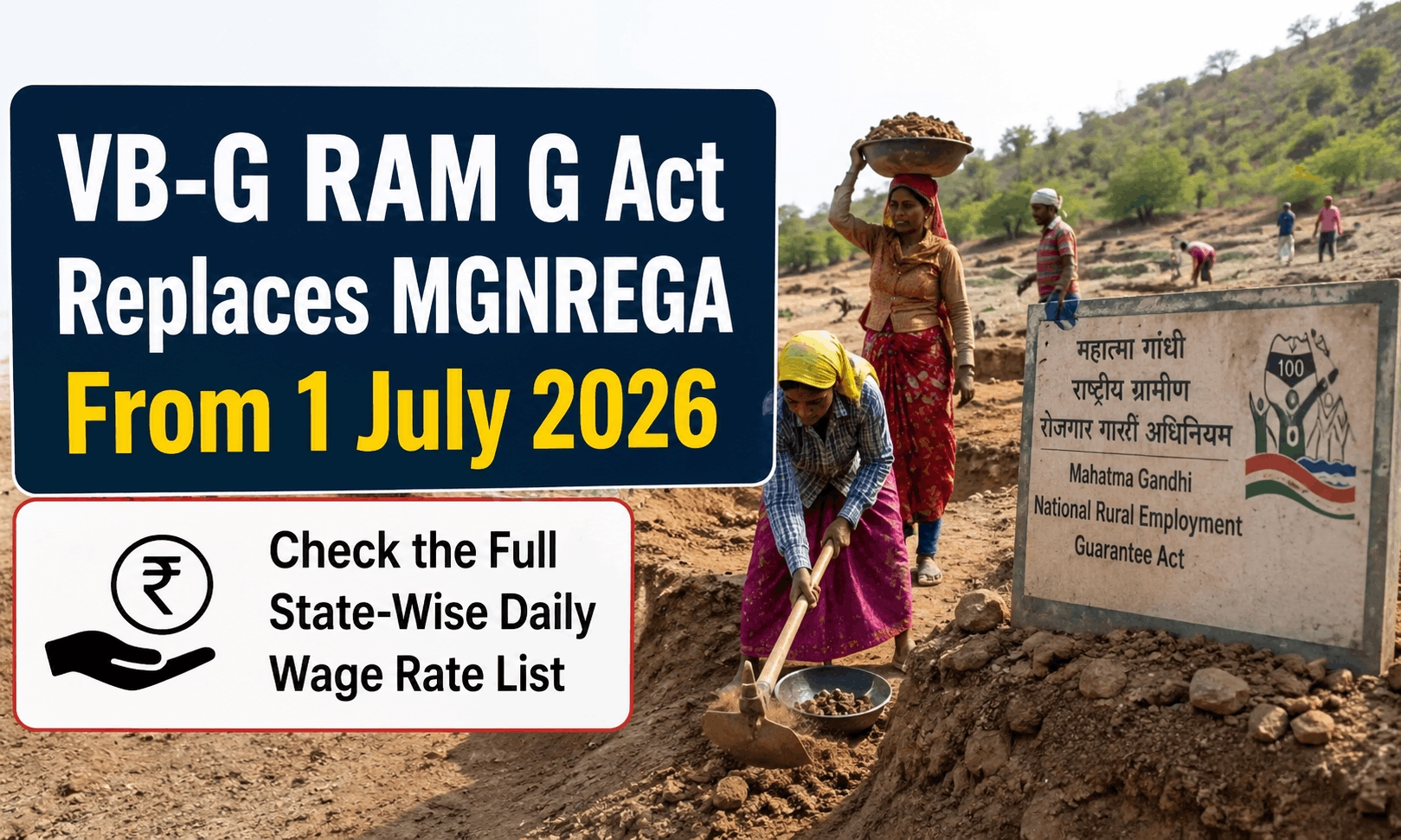
The VB-G RAM G Act has officially taken over as India’s new rural employment guarantee framework, replacing the two-decade-old Mahatma Gandhi National Rural Employment Guarantee Act (MGNREGA) from 1st July 2026. Formally known as the Viksit Bharat–Guarantee for Rozgar and Ajeevika Mission (Gramin) Act, 2025, the VB-G RAM G Act was notified by the Ministry of Rural Development on 30th June 2026, establishing revised state-wise daily wage rates for unskilled manual workers under Section 10 of the Act. This notification supersedes the Ministry’s earlier wage notification dated 26th February 2013, and it sets a nationwide minimum wage floor of ₹300 per day, with several states receiving substantial upward revisions to meet this new threshold.
Since millions of rural workers across India depend on this scheme for guaranteed employment and daily wages, understanding the exact state-wise rates and what has changed under the VB-G RAM G Act is essential for both workers and Gram Panchayat officials. This article provides the complete, verified state-wise wage rate list, key highlights of the new Act compared to the old MGNREGA framework, and answers to frequently asked questions, so rural workers can confirm their correct entitlement without relying on unverified or outdated information.
What Is the VB-G RAM G Act?
The VB-G RAM G Act stands for the Viksit Bharat–Guarantee for Rozgar and Ajeevika Mission (Gramin) Act, 2025, and it represents a comprehensive overhaul of India’s rural employment guarantee system. While the foundational goal of providing a social safety net to rural households remains consistent with the original 2005 MGNREGA framework, the new Act introduces several structural changes, including an increase in guaranteed employment from 100 days to 125 days per financial year for eligible rural households, a statutory pause of up to 60 days during peak agricultural sowing and harvesting seasons, and a shift to a strict 60:40 Centre-State funding ratio for most states, with a more favorable 90:10 ratio for North-Eastern and Himalayan states.
Under the VB-G RAM G Act, if the local administration fails to provide work within 15 days of a demand being raised, the worker becomes legally entitled to a daily unemployment allowance, preserving the fundamental income-security guarantee that made the original MGNREGA scheme so significant for rural India.
VB-G RAM G Act Key Highlights
| Full Name | Viksit Bharat–Guarantee for Rozgar and Ajeevika Mission (Gramin) Act, 2025 |
| Replaces | Mahatma Gandhi National Rural Employment Guarantee Act (MGNREGA), 2005 |
| Effective From | 1st July 2026 |
| Wage Notification Date | 30th June 2026 |
| Legal Basis for Wage Rates | Section 10 of the VB-G RAM G Act, 2025 |
| National Minimum Wage Floor | ₹300 per day |
| Guaranteed Employment Days | 125 days per financial year (up from 100 days) |
| Funding Ratio (Centre:State) | 60:40 (90:10 for North-Eastern/Himalayan states) |
| Payment Timeline | Within 15 days of work completion |
| Official Portal | vbgramg.dord.gov.in |
VB-G RAM G Act Important Dates
Candidates and rural workers tracking the transition under the VB-G RAM G Act should note the following confirmed dates:
| Event | Date |
|---|---|
| VB-G RAM G Act Notified | December 2025 |
| Previous Wage Notification (Superseded) | 26th February 2013 |
| Revised State-Wise Wage Notification | 30th June 2026 |
| VB-G RAM G Act Effective From | 1st July 2026 |
| Old Job Card Validity (Transition Period) | Valid until 31st December 2026 |
Workers should note that their existing Job Cards issued under the old MGNREGA system remain fully valid during this six-month database transition phase, so there is no need to panic or reapply immediately if the new portal shows a temporary database error message.
Full State-Wise Daily Wage Rate List Under VB-G RAM G Act
The Ministry of Rural Development has notified the following state-wise daily wage rates for unskilled manual workers under the VB-G RAM G Act, effective from 1st July 2026:
| State/Union Territory | Wage Rate (₹ per day) |
|---|---|
| Andhra Pradesh | ₹312 |
| Arunachal Pradesh | ₹300 |
| Assam | ₹300 |
| Bihar | ₹300 |
| Chhattisgarh | ₹300 |
| Goa | ₹406 |
| Gujarat | ₹300 |
| Haryana | ₹409 |
| Himachal Pradesh (Non-Scheduled Areas) | ₹300 |
| Himachal Pradesh (Scheduled Areas) | ₹375 |
| Jammu and Kashmir | ₹300 |
| Ladakh | ₹300 |
| Jharkhand | ₹300 |
| Karnataka | ₹382 |
| Kerala | ₹401 |
| Madhya Pradesh | ₹300 |
| Maharashtra | ₹317 |
| Manipur | ₹300 |
| Meghalaya | ₹300 |
| Mizoram | ₹300 |
| Nagaland | ₹300 |
| Odisha | ₹300 |
| Punjab | ₹360 |
| Rajasthan | ₹300 |
| Sikkim | ₹300 |
| Sikkim (Gnathang, Lachung, Lachen Gram Panchayats) | ₹450 |
| Tamil Nadu | ₹345 |
| Telangana | ₹308 |
| Tripura | ₹300 |
| Uttar Pradesh | ₹300 |
| Uttarakhand | ₹300 |
| West Bengal | ₹300 |
| Andaman and Nicobar Islands (Andaman District) | ₹348 |
| Andaman and Nicobar Islands (Nicobar District) | ₹367 |
| Dadra and Nagar Haveli and Daman and Diu | ₹340 |
| Lakshadweep | ₹348 |
Candidates should note that Haryana currently holds the highest standard state wage rate at ₹409 per day, closely followed by Goa at ₹406, while the special local rate for Sikkim’s Gnathang, Lachung, and Lachen Gram Panchayats stands even higher at ₹450 per day, reflecting the higher cost of living in these remote, high-altitude regions.
VB-G RAM G Act vs. Old MGNREGA: What Has Changed?
The transition from MGNREGA to the VB-G RAM G Act brings several meaningful changes for rural workers. Under the old system, eligible households were guaranteed 100 days of wage employment per financial year; this has now been increased to 125 days under the new Act, representing a 25% increase in guaranteed work opportunities. Additionally, the funding structure has shifted to a more clearly defined Centrally Sponsored Scheme model, with a standard 60:40 Centre-State split, though a more generous 90:10 ratio continues to apply for North-Eastern and Himalayan states. Under this new normative allocation system, if a state wishes to generate employment beyond its centrally capped budget, the state government must bear 100% of that additional cost itself, a significant departure from the more flexible funding arrangement under the old MGNREGA framework.
The new Act also introduces a structured 60-day statutory pause during peak agricultural sowing and harvesting seasons, designed to prevent labor shortages for local farming operations while still preserving the worker’s overall right to 125 days of guaranteed employment during the remainder of the year.
How Wages Are Verified and Paid Under VB-G RAM G Act
Digital monitoring remains a central feature of the VB-G RAM G Act, continuing the technological infrastructure built under the earlier MGNREGA system. Daily attendance at worksites is strictly monitored using biometric authentication, GPS tracking, and the National Mobile Monitoring System (NMMS) app. Once work is completed and verified, wages must be disbursed directly into the worker’s bank or post office account, typically linked through Aadhaar via the Aadhaar-Based Payment System (ABPS), within a maximum of 15 days from the date the work was completed. This 15-day payment guarantee ensures that rural workers are not left waiting indefinitely for their rightfully earned wages after completing assigned work.
How to Check Your Wage Rate and Job Card Status
Workers wishing to verify their applicable wage rate and Job Card status under the VB-G RAM G Act can follow this process:
- Visit the official national portal at vbgramg.dord.gov.in, which serves as the central hub containing nationwide data, master circulars, and core scheme guidelines.
- From the national portal, navigate to your specific state’s localized NIC sub-domain, since detailed wage records, attendance data, and Job Card information are maintained at the state level.
- Enter your Job Card number or relevant personal details as prompted by your specific state portal.
- Check your applicable daily wage rate, work attendance records, and pending payment status.
- Download or print your Job Card details for your personal records.
Since each state maintains its own localized NIC sub-domain for detailed worker-level data, candidates should specifically search for their state’s dedicated portal rather than expecting all information to be available directly on the central national hub.
Concerns and Protests Surrounding the VB-G RAM G Act
The rollout of the VB-G RAM G Act has not been entirely without controversy. Due to the new strict state-level funding caps under the normative allocation system, several major farmer and labor unions, including the All India Kisan Sabha (AIKS), announced nationwide protests around the 1st July rollout date. Additionally, reports indicate that several states have faced challenges in holding the mandatory Gram Sabha meetings required under the new framework, raising concerns among rural development observers about the pace of the transition. Workers and Panchayat officials are advised to stay updated through official government communications regarding how these concerns are being addressed as the new system stabilizes.
People Also Ask
Is MGNREGA still active in India?
No, MGNREGA has been officially replaced by the VB-G RAM G Act (Viksit Bharat–Guarantee for Rozgar and Ajeevika Mission Gramin Act, 2025) from 1st July 2026, though existing Job Cards remain valid during the transition period.
Why was MGNREGA replaced with a new Act?
The new VB-G RAM G Act was introduced to modernize the rural employment guarantee system, increase guaranteed workdays from 100 to 125 days, and create a more structured funding framework between the Centre and States.
What is the current MGNREGA wage rate in Uttar Pradesh?
Under the new VB-G RAM G Act, the wage rate for Uttar Pradesh has been set at ₹300 per day, in line with the nationwide minimum wage floor.
How can I check my state’s NREGA wage rate for 2026-27?
Workers can check their state-specific wage rate by visiting the central VB-G RAM G portal and navigating to their respective state’s localized NIC sub-domain for detailed, verified rate information.
Official Website Links
For accurate, up-to-date information regarding the VB-G RAM G Act, use the following official links:
| National VB-G RAM G Portal | https://vbgramg.dord.gov.in |
| Ministry of Rural Development | https://rural.gov.in |
| State-Wise Job Card and Wage Status Check | Accessible via your respective state’s localized NIC sub-domain, linked from the national VB-G RAM G portal homepage |
| Home Page | cbtexams.in |
FAQs
What is the VB-G RAM G Act and when did it come into effect?
The VB-G RAM G Act, formally the Viksit Bharat–Guarantee for Rozgar and Ajeevika Mission (Gramin) Act, 2025, came into effect from 1st July 2026, replacing the earlier MGNREGA framework.
What is the minimum daily wage under the VB-G RAM G Act?
The Ministry of Rural Development has fixed a nationwide minimum daily wage floor of ₹300 under the VB-G RAM G Act, with several states receiving rates higher than this baseline.
Which state has the highest daily wage rate under the VB-G RAM G Act?
Haryana currently has the highest standard state wage rate at ₹409 per day, followed by Goa at ₹406 per day.
Is my old MGNREGA Job Card still valid under the new Act?
Yes, old Job Cards remain completely valid during the six-month database transition phase, which continues until 31st December 2026.
How many days of guaranteed employment does the VB-G RAM G Act provide?
The Act guarantees 125 days of wage employment per financial year for eligible rural households, up from the earlier 100-day limit under MGNREGA.
What happens if I am not provided work within the promised timeframe?
If work is not provided within 15 days of demand, workers are legally entitled to receive a daily unemployment allowance under the VB-G RAM G Act.
How quickly are wages paid after completing work under the VB-G RAM G Act?
Wages must be disbursed directly into the worker’s bank or post office account within a maximum of 15 days from the date the work was completed.
What is the funding ratio between the Centre and States under the new Act
The standard funding ratio is 60:40 between the Centre and States, while North-Eastern and Himalayan states follow a more favorable 90:10 ratio.