
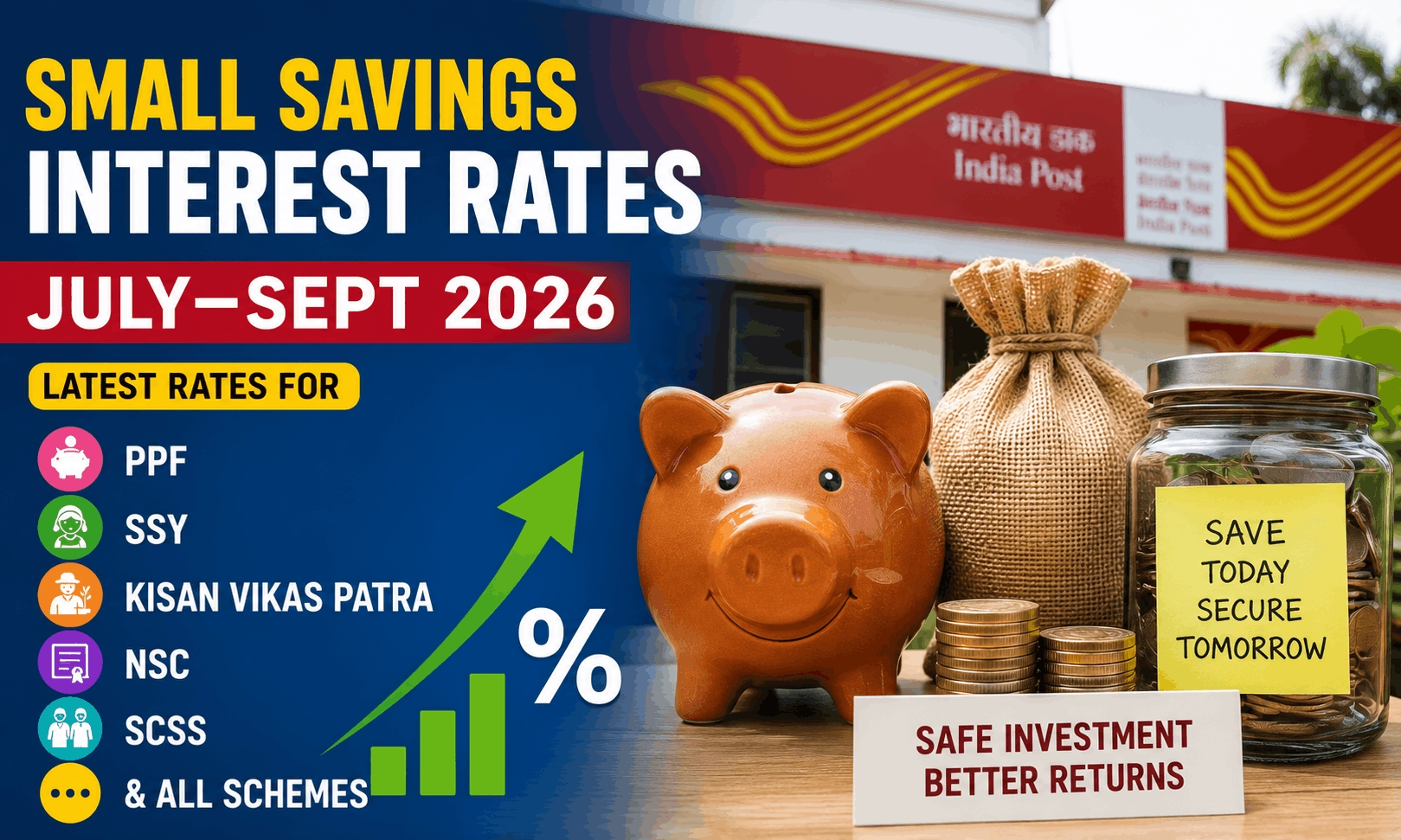
Small Savings Interest Rates July-Sept 2026 have officially been announced by the Ministry of Finance, and the government has decided to keep rates unchanged for the second quarter of FY 2026-27, covering the period from 1 July 2026 to 30 September 2026. This marks the ninth consecutive quarter without any change, offering welcome stability to millions of small savers, senior citizens, and parents who rely on these government-backed instruments for safe, predictable returns. The notification, issued by the Department of Economic Affairs on 30 June 2026, confirms that popular schemes such as the Public Provident Fund (PPF), Sukanya Samriddhi Yojana (SSY), Senior Citizens’ Savings Scheme (SCSS), National Savings Certificate (NSC), and Kisan Vikas Patra (KVP) will continue to offer the same returns as the previous quarter.
Under the latest notification, PPF continues at 7.1%, while SSY and SCSS both remain at 8.2%, the highest among all small savings instruments. NSC stays at 7.7%, and KVP remains at 7.5%, with a maturity period of 115 months. This article provides the complete, updated small savings scheme interest rate list for the July-September 2026 quarter, along with scheme-wise eligibility, tax benefits, how rates are decided, and answers to the most frequently asked questions by investors across India.
Small Savings Interest Rates July-Sept 2026 Key Highlights
| Particulars | Details |
|---|---|
| Announcing Authority | Department of Economic Affairs, Ministry of Finance |
| Notification Date | 30 June 2026 |
| Applicable Quarter | Q2, FY 2026-27 (1 July 2026 – 30 September 2026) |
| Rate Change Status | Unchanged (9th consecutive quarter) |
| Highest Interest Rate Schemes | SCSS and SSY – both at 8.2% per annum |
| PPF Interest Rate | 7.1% per annum |
| NSC Interest Rate | 7.7% per annum |
| KVP Interest Rate | 7.5% per annum (matures in 115 months) |
| POMIS Interest Rate | 7.4% per annum |
| Post Office Savings Account | 4% per annum |
| Rate Review Frequency | Quarterly |
| Official Website | nsiindia.gov.in / indiapost.gov.in |
What Are Small Savings Schemes?
Small savings schemes are a group of government-backed savings and investment instruments offered through post offices and select banks, designed to encourage disciplined savings among the general public while offering guaranteed, risk-free returns. These schemes are particularly popular among conservative investors, retirees, and parents saving for a child’s future, since they are not linked to stock market volatility and are backed by sovereign guarantee. The Ministry of Finance reviews and revises interest rates on these schemes every quarter, based on the yields of government securities (G-Secs) of comparable maturity, following a formula recommended by the Shyamala Gopinath Committee.
For the July-September 2026 quarter, the government has once again opted to maintain existing rates rather than revise them, citing broader economic stability and the need for continuity for millions of depositors.
Complete Small Savings Interest Rates List for July-September 2026
Below is the complete, scheme-wise breakdown of small savings interest rates for July-Sept 2026, as per the official Finance Ministry notification:
| Scheme | Interest Rate (Jul–Sep 2026) | Compounding Frequency |
|---|---|---|
| Public Provident Fund (PPF) | 7.1% | Annual |
| Sukanya Samriddhi Yojana (SSY) | 8.2% | Annual |
| Senior Citizens’ Savings Scheme (SCSS) | 8.2% | Quarterly (paid out) |
| National Savings Certificate (NSC) | 7.7% | Annual |
| Kisan Vikas Patra (KVP) | 7.5% (matures in 115 months) | Annual |
| Post Office Monthly Income Scheme (POMIS) | 7.4% | Monthly (paid out) |
| Post Office Savings Account (POSA) | 4.0% | Annual |
| Post Office Time Deposit – 1 Year | 6.9% | Quarterly |
| Post Office Time Deposit – 2 Year | 7.0% | Quarterly |
| Post Office Time Deposit – 3 Year | 7.1% | Quarterly |
| Post Office Time Deposit – 5 Year | 7.5% | Quarterly |
| Post Office Recurring Deposit (RD) – 5 Year | 6.7% | Quarterly |
PPF Interest Rate July-Sept 2026: Key Details
The Public Provident Fund (PPF) interest rate for the July-September 2026 quarter remains steady at 7.1% per annum, unchanged from the previous quarter. PPF continues to be one of the most preferred long-term savings instruments in India because of its EEE (Exempt-Exempt-Exempt) tax status — meaning the deposit, the interest earned, and the maturity amount are all completely tax-free. The scheme has a 15-year lock-in period, extendable in blocks of 5 years, and requires a minimum annual deposit of ₹500, with a maximum contribution limit of ₹1,50,000 per financial year.
Sukanya Samriddhi Yojana (SSY) Interest Rate July-Sept 2026
The Sukanya Samriddhi Yojana interest rate stays at 8.2% per annum for this quarter, making it one of the two highest-yielding small savings schemes currently available. SSY is specifically designed for the financial security of a girl child below the age of 10 years, and the account can be opened by parents or legal guardians with a minimum deposit of ₹250 per year, up to a maximum of ₹1,50,000 annually. The scheme matures after 21 years from the date of account opening, or upon the girl’s marriage after she turns 18, whichever is earlier.
Senior Citizens’ Savings Scheme (SCSS) Interest Rate July-Sept 2026
The SCSS interest rate also remains unchanged at 8.2% per annum, and unlike PPF or SSY, the interest here is paid out quarterly rather than compounded, making it especially suitable for retirees who depend on a regular income stream. SCSS is available to individuals aged 60 years and above, with certain relaxations for retired defence personnel and civilian employees who meet specific age and retirement criteria. The maximum investment limit under SCSS is ₹30 lakh, and the scheme has a tenure of 5 years, extendable by an additional 3 years.
National Savings Certificate (NSC) Interest Rate July-Sept 2026
The NSC interest rate for this quarter continues at 7.7% per annum, compounded annually but payable only at maturity. NSC has a fixed tenure of 5 years and is a popular choice for tax-saving investments under Section 80C of the Income Tax Act. It’s important to note that once purchased, the interest rate on an NSC certificate is locked for its entire tenure — quarterly rate revisions only apply to fresh certificates purchased during that specific quarter, not to certificates already held by existing investors.
Kisan Vikas Patra (KVP) Interest Rate July-Sept 2026
The Kisan Vikas Patra interest rate remains at 7.5% per annum for the July-September 2026 quarter, with the investment amount doubling in 115 months (approximately 9 years and 7 months) at this rate. Like NSC, the rate applicable to a KVP certificate is fixed at the time of purchase and does not change during its tenure, even if the government revises rates for new investors in subsequent quarters. KVP has no maximum investment limit and can be purchased by individuals, joint holders, or on behalf of a minor.
Why Did the Government Keep Small Savings Rates Unchanged?
The Ministry of Finance’s decision to hold rates steady for the ninth straight quarter reflects a deliberate policy of stability and predictability for small savers, particularly retirees, salaried individuals, and parents relying on these schemes for long-term goals. Since small savings rates are benchmarked to the yields of comparable government securities, the ministry retains flexibility to revise rates each quarter but may choose not to, depending on prevailing bond market conditions and broader macroeconomic considerations. The current decision suggests that G-Sec yields have remained largely stable, supporting the case for continuity rather than an upward or downward revision this quarter.
How to Open a Small Savings Scheme Account
Most small savings schemes, including PPF, SSY, SCSS, and NSC, can be opened at any post office branch, and several — such as PPF and SCSS — are also available through designated public and private sector banks. To open an account, investors generally need to follow these steps:
- Visit your nearest post office or a bank branch authorised to offer the scheme.
- Collect and fill out the account opening form for the specific scheme (PPF, SSY, SCSS, NSC, or KVP).
- Submit KYC documents, including Aadhaar card, PAN card, and a passport-size photograph.
- For SSY, additionally submit the girl child’s birth certificate.
- Make the minimum required initial deposit as per the scheme’s rules.
- Collect your passbook or certificate and preserve it safely for future reference and withdrawals.
Tax Benefits Under Small Savings Schemes
| Scheme | Tax Treatment |
|---|---|
| PPF | Fully tax-free (EEE) — deposit, interest, and maturity amount all exempt |
| SSY | Fully tax-free (EEE), along with 80C deduction on deposits |
| SCSS | 80C deduction available; interest is taxable, subject to TDS above ₹1 lakh/year (Form 15H/15G can help avoid TDS where applicable) |
| NSC | 80C deduction available; interest is taxable as “Income from Other Sources” each year, even though paid at maturity |
| KVP | No 80C deduction; interest is fully taxable at maturity |
People Also Ask
How often does the government revise small savings interest rates?
The Ministry of Finance reviews small savings interest rates every quarter, based on the yields of comparable government securities, though it may choose to leave rates unchanged, as it has for nine consecutive quarters now.
What is the minimum and maximum deposit limit for Sukanya Samriddhi Yojana?
The minimum annual deposit is ₹250, while the maximum permissible deposit is ₹1,50,000 per financial year under the Sukanya Samriddhi Yojana.
Is Senior Citizens’ Savings Scheme (SCSS) interest paid monthly or quarterly?
SCSS interest is paid out quarterly, unlike PPF and SSY, which compound annually and are paid only at maturity or withdrawal.
Where can I open a small savings scheme account?
Most schemes, including PPF, SSY, SCSS, NSC, and KVP, can be opened at any post office branch, and select schemes like PPF and SCSS are also available at designated public and private sector banks.
Official Website and Important Links
| Purpose | Link |
|---|---|
| National Savings Institute (Official Rates & Notifications) | nsiindia.gov.in |
| India Post – Small Savings Schemes | indiapost.gov.in |
| Department of Economic Affairs, Ministry of Finance | dea.gov.in |
| Home Page | cbtexams.in |
Investors are strongly advised to rely only on these official government websites for the latest interest rate notifications, scheme rules, and account-related services, rather than unverified sources.
FAQs
What is the current PPF interest rate for July-September 2026?
The PPF interest rate remains unchanged at 7.1% per annum for the July-September 2026 quarter.
Which small savings scheme offers the highest interest rate in 2026?
SCSS (Senior Citizens’ Savings Scheme) and SSY (Sukanya Samriddhi Yojana) both offer the highest rate among small savings schemes, at 8.2% per annum.
Has the government changed small savings interest rates for this quarter?
No. The government has kept rates unchanged for the ninth consecutive quarter, as per the notification dated 30 June 2026.
What is the NSC interest rate for July-September 2026?
The National Savings Certificate (NSC) interest rate stands at 7.7% per annum, unchanged from the previous quarter.
Does the interest rate on my existing NSC or KVP change every quarter?
No. The interest rate on NSC and KVP is locked at the time of purchase and remains the same for the entire tenure. Quarterly rate revisions apply only to fresh certificates purchased in that quarter.
What is the Kisan Vikas Patra maturity period for July-September 2026?
At the current rate of 7.5% per annum, a Kisan Vikas Patra investment matures and doubles in 115 months (about 9 years and 7 months).
Who is eligible to open a Senior Citizens’ Savings Scheme (SCSS) account?
Individuals aged 60 years and above are eligible, with certain age relaxations available for retired defence and civilian government employees who meet specific retirement conditions.
Is PPF interest taxable?
No. PPF falls under the EEE (Exempt-Exempt-Exempt) tax category, meaning the deposit, interest earned, and maturity amount are all completely tax-free.