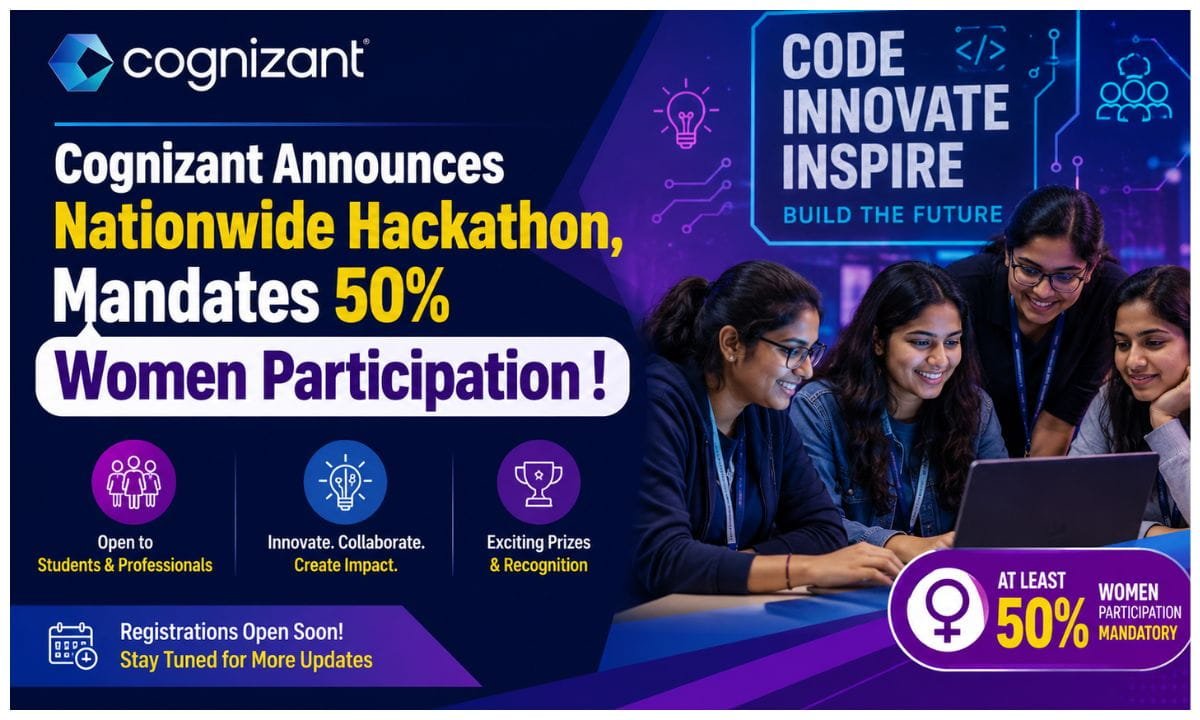
Cognizant Hackathon 2026 Women Participation: Cognizant has rolled out the third edition of its flagship student-facing initiative, the Technoverse Hackathon 2026, a nationwide competition designed to give engineering students hands-on exposure to enterprise-grade AI problem-solving. What sets this year’s edition apart, and what has drawn significant attention across campuses and the tech media, is the company’s explicit mandate requiring at least 50% women’s participation in every team.
Here is a complete look at what the hackathon involves, how it is structured, and why the gender-inclusion mandate matters.
What Is the Cognizant Hackathon 2026?
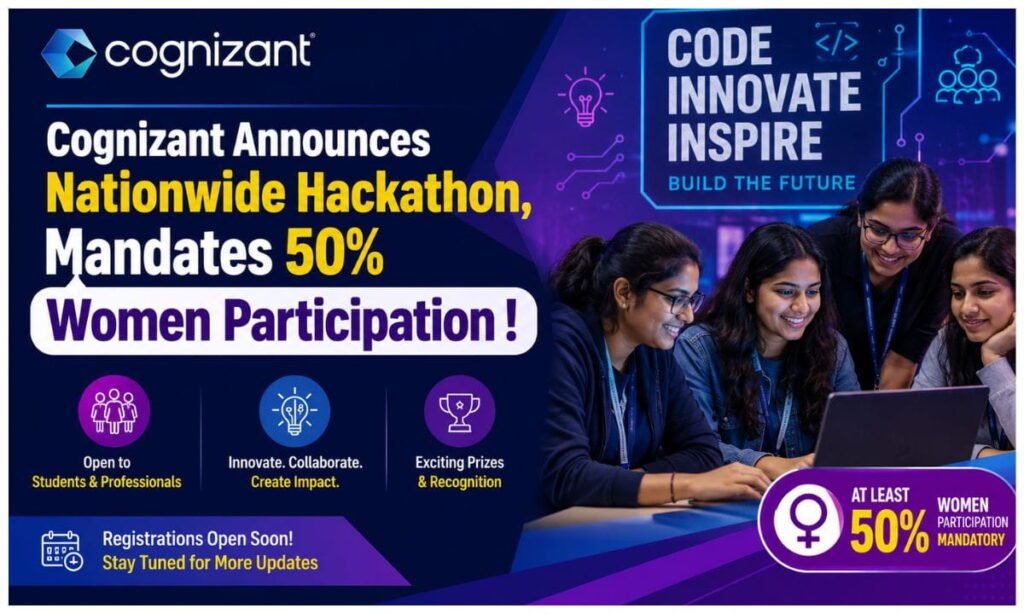
Cognizant has announced the Technoverse Hackathon 2026, a nationwide initiative inviting pre-final year engineering students from across India to build AI-powered solutions for live industry problems. The Cognizant Hackathon 2026 is positioned as a bridge between academic learning and practical problem-solving, with a strong focus on diversity and inclusion through a 50% women-participation mandate.
This is the third edition of Cognizant’s student-facing hackathon, and it has been scaled to reach over 20,000 students from more than 400 colleges across India, making it one of the larger student hackathons run by a major IT services company in the country this year. The Cognizant Hackathon 2026 targets students from the 2027 graduating batch of engineers, giving pre-final year students a chance to work on live problems well before they enter campus placement season.
Cognizant Hackathon 2026 – Structure, Themes, and Technology
Participants are expected to develop AI-driven prototypes that address real-world challenges in domains such as banking, healthcare, retail, manufacturing, and energy, using themes and technology stacks curated by Cognizant. This has since been detailed further, with Cognizant confirming the specific industry verticals students can choose from. Participants will build solutions across several high-impact domains such as Banking, Insurance, Healthcare, Life Sciences, Retail, Manufacturing, Communications, Media and Technology, and Energy and Utilities.
The entire Cognizant Hackathon 2026 is structured around Generative AI and modern engineering practices, with students building minimum viable products (MVPs) in an AWS environment provided by Cognizant. On the technical side, Cognizant has laid out clear recommendations for participants to follow. Cognizant recommends Python, Java, and JavaScript or TypeScript as programming languages, with React, Angular, or Vue for front-end development and Spring Boot, FastAPI, or Node.js for back-end development.
Teams must choose one of the Cognizant-curated themes and build an AI-driven solution using the technology stacks recommended by the company, with the central thrust being AI-led enterprise problem-solving, where students demonstrate how Gen-AI and modern engineering can address operational, customer-experience, or efficiency bottlenecks in live business contexts.
The 50% Women Participation Mandate
The standout feature of this year’s hackathon is undoubtedly its gender-inclusion requirement, which is not a soft target but a hard eligibility condition for team registration. Each team must consist of exactly four members, with at least two female members required to fulfil the mandatory 50% women participation requirement in Cognizant Hackathon 2026, and team composition cannot be changed once registration is submitted.
This is reiterated in the official communication sent to partner colleges. Each team should have at least 50% women participation, attending a design thinking awareness session is mandatory post-registration, and teams must choose a theme from the industry domains provided by Cognizant while developing their MVP using Cognizant-recommended technologies in an AWS environment.
Cognizant leadership has framed this mandate as part of a broader push toward equal representation in the tech pipeline. The company said the hackathon reinforces equal representation with 50 per cent women’s participation, in tune with the company’s commitment to inclusive growth. Rajesh Varrier, President of Global Operations and Chairman and Managing Director of Cognizant India, described the hackathon as a platform where India’s brightest engineering minds tackle real industry challenges, think at an enterprise scale, and take their first steps toward becoming the technology leaders of tomorrow.
Beyond the optics, the mandate is expected to have tangible downstream effects. The 50% women-participation mandate signals a clear move toward more inclusive tech ecosystems, giving women-identified students a visible and structured entry point into AI-driven innovation.
Cognizant Hackathon 2026 – Registration Process and Eligibility
- Registration for the Cognizant Hackathon 2026 was managed centrally through a digital platform, with strict rules around team formation to prevent last-minute manipulation of the gender ratio.
- Registration for the Cognizant Technoverse Hackathon 2026 was managed through the Superset platform, with every team member required to first create and verify an individual account using their college email ID before a team could be formed.
- The team owner would then create the team on the platform and invite three other members, ensuring at least two of the four members were female to meet the participation requirement, and confirming that all members were already registered on Superset before sending invitations, since unregistered users could not accept team invitations. Registration closed on 10 April 2026.
- Not every engineering student in India was eligible to apply independently. Registrations were exclusive to students from Cognizant’s selected partner colleges, and students from non-partner institutions could not participate independently.
- The rules also guarded against participants gaming the team-formation process. Team composition cannot be altered once registration is completed, a participant is permitted to join only one team for the entire duration of the hackathon, each team must have a unique name, and participants must register using only their Superset-registered email IDs.
Post-Registration Requirements
Once teams were formed, participation did not stop at just submitting a project idea. Cognizant built in a mandatory orientation component aimed at grounding students in structured problem-solving before they began building.
After completing registration, all team members were required to attend a mandatory design thinking awareness session, which appears designed to align student thinking with the kind of structured, enterprise-style problem framing that Cognizant’s own consultants use with clients. Sessions of this nature were used to discuss industry and business trends, needs, and scenarios, and provide participants an approximate sense of market context before they began solutioning.
Timeline and Final Round
The Cognizant Hackathon 2026 runs across several weeks, moving from theme selection and MVP development to a final in-person round. The competition is conducted over a few weeks, culminating in May 2026, when the top threeteams are identified and felicitated at a ceremony hosted at a Cognizant facility in Pune. This culminating event has since been confirmed with an exact date.
The final MVP development phase is a 24-hour in-person hackathon held at Cognizant’s Pune facility on 6 May 2026, with only shortlisted teams invited to this stage, and teams responsible for making their own travel and accommodation arrangements for the Pune visit.
Prizes and Career Opportunities
Beyond recognition, Cognizant has tied in meaningful career incentives for participants who make it through to the later rounds. The top 3 teams win prizes worth a combined Rs. 5 lakhs, along with Cognizant internship opportunities, merchandise, and certificates, and all teams that reach the final round are also eligible for Cognizant internship opportunities and receive certificates and merchandise.
This effectively turns the Cognizant Hackathon 2026 into a talent pipeline for Cognizant, allowing the company to identify and fast-track promising students, including a guaranteed cohort of women engineers, well ahead of the traditional campus placement cycle.
Why This Matters?
The Cognizant Hackathon 2026 emphasizes gender inclusivity, with half of the participants required to be women, and as the event progresses towards its May conclusion, it reinforces Cognizant’s commitment to upskilling, mirroring the success of its Synapse program, which has previously focused on large-scale AI skilling efforts.
By embedding a hard 50% women’s participation requirement in Cognizant Hackathon 2026 directly into eligibility rules rather than treating it as an aspirational target, Cognizant has set a structural precedent that other large-scale corporate hackathons in India may find themselves measured against. Combined with its scale — reaching over 20,000 students across 400-plus colleges — the Technoverse Hackathon 2026 stands out as one of the more ambitious attempts by an Indian IT major to simultaneously build an AI-skilled talent pipeline and move the needle on gender representation in tech from the campus level itself.
FAQ’s on Cognizant Hackathon 2026
What is Cognizant’s nationwide hackathon?
Cognizant’s nationwide hackathon is a coding and innovation competition that invites students and technology enthusiasts to solve real-world business and technology challenges. Participants can showcase their programming, problem-solving, and teamwork skills.
Who is eligible to participate in the hackathon?
Eligibility criteria may vary for each edition, but the hackathon is generally open to eligible college students and, in some cases, young professionals. Participants should check the official registration guidelines for detailed requirements.
How can I register for the Cognizant nationwide hackathon?
Interested candidates can register via the official Cognizant hackathon or career portal once registration opens. Applicants should fill out the online form and follow the instructions provided during the registration process.
What are the benefits of participating in the hackathon?
Participants can gain practical experience, enhance their coding and innovation skills, network with industry experts, compete for prizes, and potentially secure internships or career opportunities based on their performance.